
Ingredients
Equipment
Method
- Line a 9×5 inch (23×13cm) loaf pan with parchment paper, pressing it flat against the bottom and sides with at least 2 inches (5cm) of overhang on both long edges — do not grease the pan before lining.
- Pour 2 cups (480ml) cold heavy whipping cream and ¼ cup (50g) plain white granulated cane sugar into a large chilled mixing bowl and whip on medium speed for 1 minute, then medium-high for 1–2 minutes until the cream holds soft, drooping peaks — stop immediately when peaks droop softly and do not stand straight up.
- Spread 3–4 tablespoons (45–60g) of whipped cream in a thin, even layer across the bottom of the lined pan to create a base for the first cookie layer.
- Place a single layer of Lotus Biscoff cookies over the base cream, fitting them as closely together as possible and breaking cookies to fill any gaps at the ends — press each cookie gently into the cream below without pushing through.
- Warm ¼ cup (65g) Lotus Biscoff cookie butter spread in the microwave for 10–15 seconds, stir until smooth, and spread a thin, even layer over the cookie layer — the cookie butter should be spreadable but not runny, and should cover the cookies edge to edge.
- Spread a generous layer of whipped cream — approximately ½ cup (120ml) volume — evenly over the cookie butter layer using an offset spatula, working from center outward until the cookies are fully covered and the surface is level.
- Repeat steps 4 through 6 — cookie layer, cookie butter spread, cream layer — until the pan is full, finishing with a final cream layer on top approximately ½ inch (1.25cm) thick.
- Press plastic wrap lightly against the top cream surface to prevent skin formation, then refrigerate on a flat, level shelf for a minimum of 8 hours — overnight, 8 to 10 hours, is the target for fully softened, cake-like cookie layers.
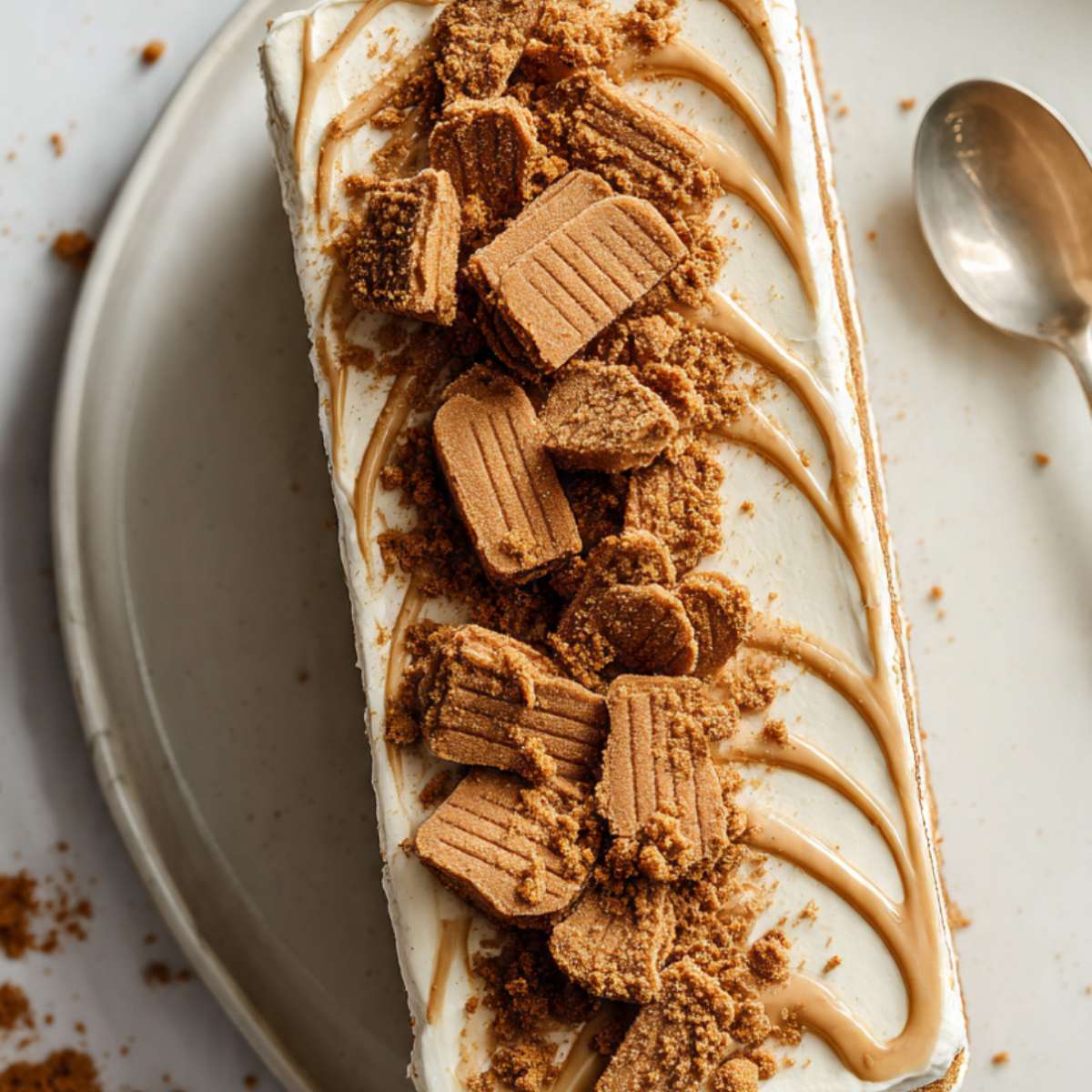
- Once the cake is fully set, warm the remaining ¼ cup (65g) Lotus Biscoff cookie butter spread in the microwave for 15–20 seconds until just pourable, then drizzle in long sweeping ribbon lines across the top cream surface using a piping bag or spoon.
- Scatter the finely crushed Biscoff cookie crumbs across the top surface, then press the broken whole Biscoff cookie pieces gently into the cream so they rest on the surface without sinking — decorate immediately before serving, not before chilling.
- Grip both parchment overhangs and lift the cake straight up and out of the loaf pan onto a cutting board, then slice into 9 pieces approximately 1 to 1.5 inches (2.5–4cm) thick using a sharp knife wiped clean between every cut — serve immediately, cold.
Notes
- Biscoff cookies: Use only Lotus Biscoff original
rectangular cookies in the red packaging — not
sandwich cookies, not other speculoos brands.
Sandwich cookies contain a cream filling that
changes the softening rate and layer texture. - Heavy cream: Must be 36% fat or higher and cold
straight from the refrigerator. Cream below 36%
fat will not whip to stable peaks. - Cookie butter: Use creamy, not crunchy. Warm in
10-second microwave increments — too hot will melt
the cream layers on contact. - Cookie butter between layers: Divide the ¼ cup
(65g) evenly across however many cookie layers
your pan produces — approximately one-third per
layer for a 3-layer build. - Storage: Store in the loaf pan with plastic wrap
pressed against cut surfaces, refrigerated, up to
3 days. Do not store at room temperature. - Freeze: Freeze undecorated individual slices only,
wrapped tightly in plastic wrap then a zip-lock
freezer bag, up to 4 weeks — thaw overnight in
the refrigerator and decorate after thawing. - Make ahead: Assemble through the layering step up
to 24 hours in advance — add cookie butter drizzle
and cookie decoration immediately before serving
only. - Scaling: The recipe doubles cleanly into a 9×13
inch (23×33cm) pan — add 2–3 hours to minimum
chilling time for the larger, thicker build. - Altitude: At high altitude, cream whips faster —
reduce mixer speed by one setting and check peaks
every 30 seconds from the 90-second mark onward. - Allergens: Contains wheat (Biscoff cookies), dairy
(heavy cream, cookie butter), soy (cookie butter).
Check packaging for current allergen information
as formulations vary by region. - Tip: Chill your mixing bowl and beaters in the
freezer for 10 minutes before whipping the cream —
a cold bowl produces faster, more stable peaks
especially in warm kitchens.
rectangular cookies in the red packaging — not
sandwich cookies, not other speculoos brands.
Sandwich cookies contain a cream filling that
changes the softening rate and layer texture. - Heavy cream: Must be 36% fat or higher and cold
straight from the refrigerator. Cream below 36%
fat will not whip to stable peaks. - Cookie butter: Use creamy, not crunchy. Warm in
10-second microwave increments — too hot will melt
the cream layers on contact. - Cookie butter between layers: Divide the ¼ cup
(65g) evenly across however many cookie layers
your pan produces — approximately one-third per
layer for a 3-layer build. - Storage: Store in the loaf pan with plastic wrap
pressed against cut surfaces, refrigerated, up to
3 days. Do not store at room temperature. - Freeze: Freeze undecorated individual slices only,
wrapped tightly in plastic wrap then a zip-lock
freezer bag, up to 4 weeks — thaw overnight in
the refrigerator and decorate after thawing. - Make ahead: Assemble through the layering step up
to 24 hours in advance — add cookie butter drizzle
and cookie decoration immediately before serving
only. - Scaling: The recipe doubles cleanly into a 9×13
inch (23×33cm) pan — add 2–3 hours to minimum
chilling time for the larger, thicker build. - Altitude: At high altitude, cream whips faster —
reduce mixer speed by one setting and check peaks
every 30 seconds from the 90-second mark onward. - Allergens: Contains wheat (Biscoff cookies), dairy
(heavy cream, cookie butter), soy (cookie butter).
Check packaging for current allergen information
as formulations vary by region. - Tip: Chill your mixing bowl and beaters in the
freezer for 10 minutes before whipping the cream —
a cold bowl produces faster, more stable peaks
especially in warm kitchens.