
Ingredients
Equipment
Method
- Position the oven rack in the middle slot and heat the oven to 350°F (175°C), then line a light-colored aluminum baking sheet with parchment paper and set aside.
- Add the creamy commercial peanut butter, softened unsalted butter, and plain white granulated cane sugar to a large mixing bowl and stir with a silicone spatula using firm strokes from the bottom of the bowl upward for approximately 40 to 50 strokes until the mixture looks smooth, thick, and uniform with no visible butter streaks remaining.
- Add the room-temperature large egg to the bowl and stir with wide circular strokes for approximately 25 to 30 strokes until the mixture looks glossy and fully uniform with no egg streaks visible.
- Add the all-purpose flour, baking soda, and fine sea salt to the bowl and fold with slow deliberate strokes from the bottom of the bowl upward for approximately 15 to 20 strokes until no dry flour is visible — do not overmix.
- Add the old-fashioned rolled oats and peanut butter chips to the bowl and fold for approximately 15 to 20 strokes until the oats and chips are evenly distributed throughout the dough.
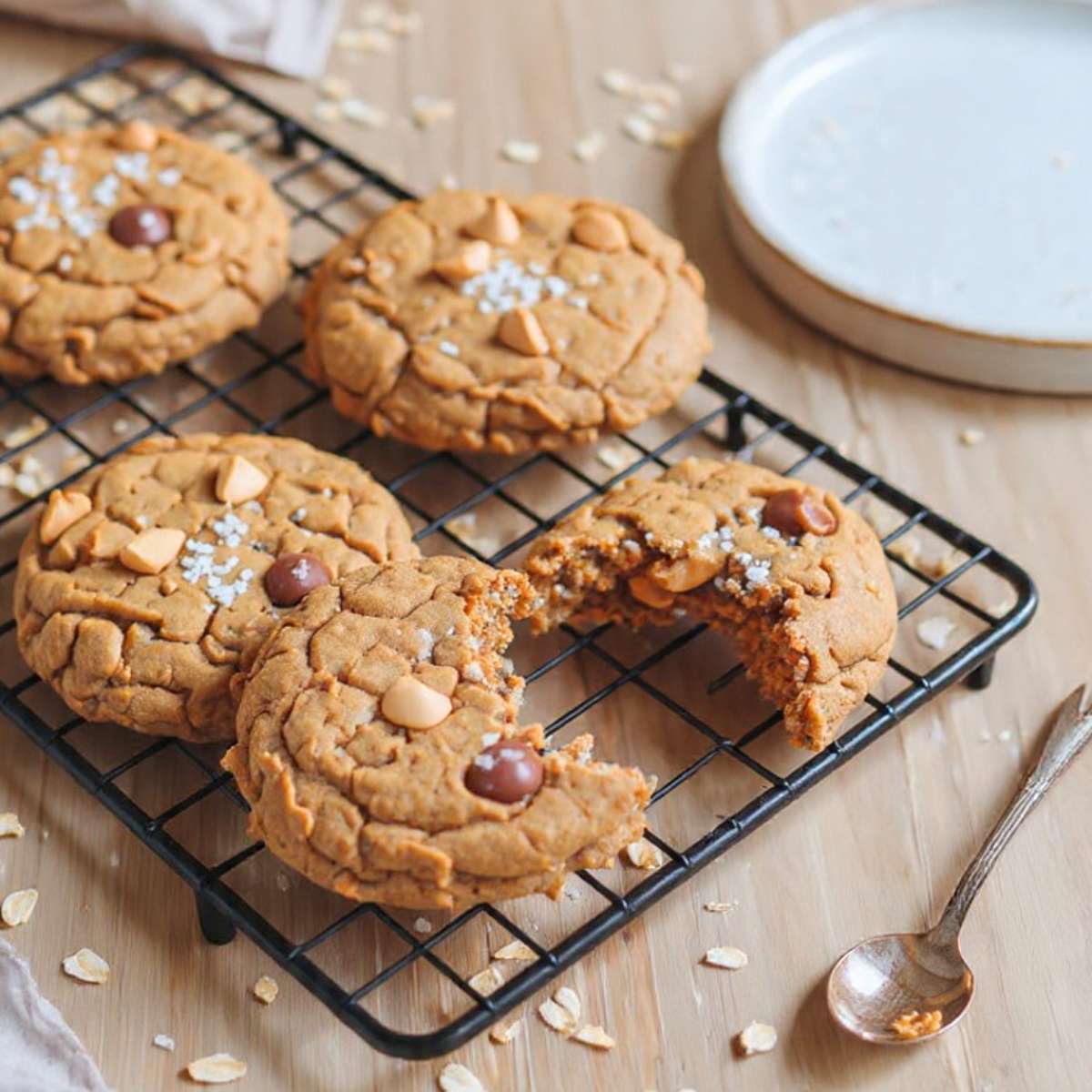
- Scoop 2 tablespoons (45g) of dough per cookie and place as tall mounds on the prepared baking sheet, spacing each mound at least 2 inches (5cm) apart — do not press the dough flat.
- Bake on the middle rack at 350°F (175°C) for 10 to 12 minutes until the edges look golden and set and the centers still look slightly soft and underdone — do not wait for the centers to look fully set.
- Immediately after pulling the pan from the oven, sprinkle flaky sea salt over the top of each cookie, then leave the cookies on the hot pan for exactly 5 minutes before transferring to a wire cooling rack to cool completely.
Notes
- Peanut butter: Use creamy commercial peanut butter such as Jif or Skippy only — natural peanut butter where the oil separates will cause the dough to crumble and fall apart.
- Oats: Use old-fashioned rolled oats only — quick oats or instant oats will produce a uniform, paste-like texture with no chew or visible oat character.
- Butter: Must be softened to 65–68°F (18–20°C) — butter that is too warm causes excessive spread. Pull from the fridge 60 to 90 minutes before baking.
- Egg: Must be room temperature — pull from the fridge 30 minutes before baking or place in warm water for 10 minutes.
- Baking soda: Check freshness before using — drop ½ tsp into hot water with white vinegar; it should bubble aggressively within 2 seconds.
- Flour: Spoon into the measuring cup and level — never scoop directly from the bag. Or weigh at 90g.
- Storage: Lidded hard-sided container with parchment between layers, room temperature up to 4 days. Do not use zip-lock bags.
- Freeze baked: Wrap individually in plastic wrap, freeze up to 2 months. Thaw at room temperature 30 to 45 minutes.
- Freeze unbaked: Freeze portioned dough balls solid on a tray, transfer to a freezer bag, store up to 3 months. Bake from frozen at 350°F (175°C) for 13 to 14 minutes.
- Scaling: All ingredients double except baking soda — use ¾ tsp (4.5g) for a doubled batch, not 1 full tsp.
- High altitude: Reduce baking soda to ¼ tsp (1.5g), increase oven temperature to 365°F (185°C), check at 9 minutes.
- High altitude bakers: see the FAQ section for adjustment guidelines.
- Allergens: Contains peanuts, wheat (gluten), eggs, and dairy. Peanut butter chips may contain additional allergens — check packaging.
- Make-ahead: Dough balls can be portioned and refrigerated covered for up to 48 hours before baking, or frozen for up to 3 months — bake from frozen at 350°F (175°C) for 13 to 14 minutes.
- Pro-tip: Press 4 to 5 extra peanut butter chips onto the top of each dough ball immediately before baking for visible chips on every finished cookie.