
Ingredients
Equipment
Method
- Position oven rack in the middle and preheat to 350°F (175°C), then line a light-colored aluminum baking sheet with parchment paper and set aside.
- In a large mixing bowl, use a sturdy silicone spatula to work together the softened butter, packed brown sugar, and granulated sugar with firm pressing and folding strokes for 2 to 3 minutes until smooth, uniform, and slightly lighter in color.
- Add the eggs one at a time, stirring firmly after each addition until fully absorbed with no egg streaks remaining, then stir in the vanilla extract.
- Add the flour, baking soda, cinnamon, and fine sea salt directly to the bowl and fold with slow bottom-to-top strokes for 12 to 15 strokes until just combined with no visible dry flour pockets.
- Add the old-fashioned rolled oats and fold with the same slow strokes for 20 to 25 strokes until evenly distributed — the dough will be very thick and stiff.
- Scoop 1.5 tablespoons (38g) of dough per cookie, roll briefly into a rough ball, and place 2 inches (5cm) apart on the prepared baking sheet — do not flatten.
- Bake at 350°F (175°C) for 11 to 13 minutes until the edges are set and lightly golden and the centers still look slightly underdone and soft — do not wait for the centers to look fully baked.
- Leave cookies on the hot pan for exactly 5 minutes, then transfer to a wire cooling rack and cool completely to room temperature — approximately 45 to 60 minutes — before filling.
- To make the filling, beat the softened butter alone in a stand mixer fitted with the paddle attachment on medium speed for 2 full minutes until pale yellow and increased in volume.
- Add the sifted powdered sugar one cup at a time, mixing on low speed until absorbed then increasing to medium for 1 minute after each addition.
- Add the marshmallow fluff, vanilla extract, and pinch of fine sea salt and beat on medium speed for 1 to 2 minutes until the filling is smooth, glossy, and holds a soft peak.
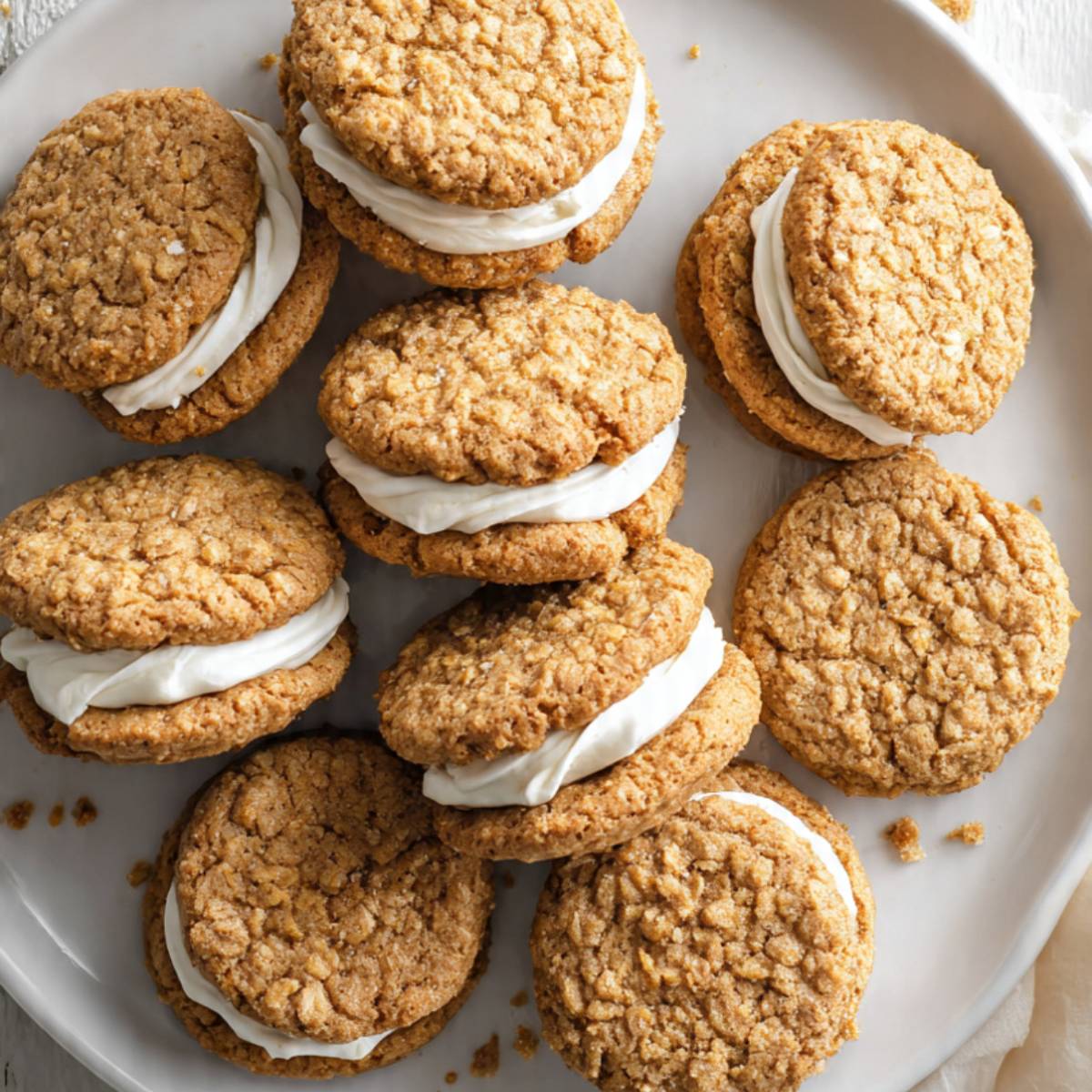
- Pair cookies by size, flip half bottom-side up, and pipe or spread 2 to 2.5 tablespoons (38–45g) of filling onto each base cookie leaving a ¼ inch (6mm) border from the edge.
- Press the top cookie down firmly but gently until the filling reaches the edge all the way around, then refrigerate assembled sandwiches for 20 minutes before serving to allow the filling to firm slightly.
Notes
- Butter (cookies): must be 65–68°F — leaves a clean finger indent with no shine. Too warm = flat, spreading cookies.
- Butter (filling): same temperature range — beaten alone 2 full minutes before sugar goes in. Under-beaten = dense, heavy filling.
- Oats: old-fashioned rolled oats only — quick oats dissolve into dough and produce a mushy cookie without visible oat texture.
- Baking soda: drop ½ tsp into hot water with vinegar — aggressive bubbling within 2 seconds confirms freshness. Replace if weak.
- Powdered sugar: sift before measuring — un-sifted clumps produce a grainy filling that does not beat out.
- Marshmallow fluff: use Jet-Puffed or Marshmallow Fluff brand — not marshmallow sauce, which is thinner and makes the filling runny.
- Cinnamon: should smell sharp and spicy when opened — replace if faint. Potency fades within 6 months of opening.
- Storage: airtight rigid container at room temperature up to 3 days. Do not refrigerate — dries cookies faster than room-temp air.
- Freeze assembled: single layer until firm, then freezer bag with parchment between layers — up to 2 months. Thaw 30–45 min at room temp.
- Freeze unbaked dough: freeze scooped dough balls up to 2 months — bake from frozen at 350°F, add 2 to 3 minutes to bake time.
- Make ahead: bake cookies up to 1 day ahead — oat flavor deepens overnight. Make filling fresh on assembly day.
- Scaling: this recipe doubles cleanly. Leavening does not scale linearly beyond a double batch — do not triple the baking soda.
- Altitude: above 3,500 ft, reduce baking soda to ¾ tsp and increase flour by 2 tablespoons.
- Allergens: contains gluten, dairy, and eggs. Check marshmallow fluff label for additional allergens by brand.
- Tip: refrigerate assembled sandwiches 20 minutes before serving — filling firms against the cookie for a cleaner bite and better structure.