
Ingredients
Equipment
Method
- Position the oven rack in the middle slot and heat the oven to 350°F (175°C), then line a 9x13 inch (23x33cm) light-colored aluminum baking pan with parchment paper leaving a 2-inch (5cm) overhang on both long sides and lightly grease the two short ends where the parchment does not reach.
- Melt ¾ cup (170g) unsalted butter completely and pour into a large mixing bowl, then set aside to cool for 8–12 minutes until the bowl feels neutral against your wrist and the butter registers below 90°F (32°C) on an instant-read thermometer before moving to the next step.
- Add ¾ cup (150g) packed light brown sugar and ¼ cup (50g) plain white granulated cane sugar to the cooled melted butter and stir from the bottom of the bowl upward in slow wide circular strokes for approximately 40 to 50 strokes until no dry sugar pockets remain and the mixture looks thick, dark amber, and slightly grainy.
- Add 2 large room-temperature eggs one at a time stirring vigorously for approximately 30 strokes after each addition until the mixture looks thick, smooth, and glossy with no visible egg streaks, then stir for an additional 20 strokes after the second egg is fully incorporated, add 1 teaspoon (5ml) pure vanilla extract, and stir for 5 more strokes until fully combined.
- Add 2 cups (240g) all-purpose flour spooned and leveled, 1 teaspoon (6g) baking soda, and ½ teaspoon (3g) fine sea salt directly to the batter and fold from the bottom of the bowl upward in slow deliberate strokes stopping at the exact moment no dry flour is visible — approximately 20 to 25 strokes — the dough will be thick, sticky, and heavy and should not look smooth or shiny.
- Add 1½ cups (255g) semi-sweet chocolate chips (45–55% cacao) and fold with 8 to 10 slow strokes until the chips are evenly distributed throughout the dough, reserving approximately 2 tablespoons (20g) of chips to press onto the surface after spreading, and adding ½ cup (60g) toasted roughly chopped walnuts at this stage if using.
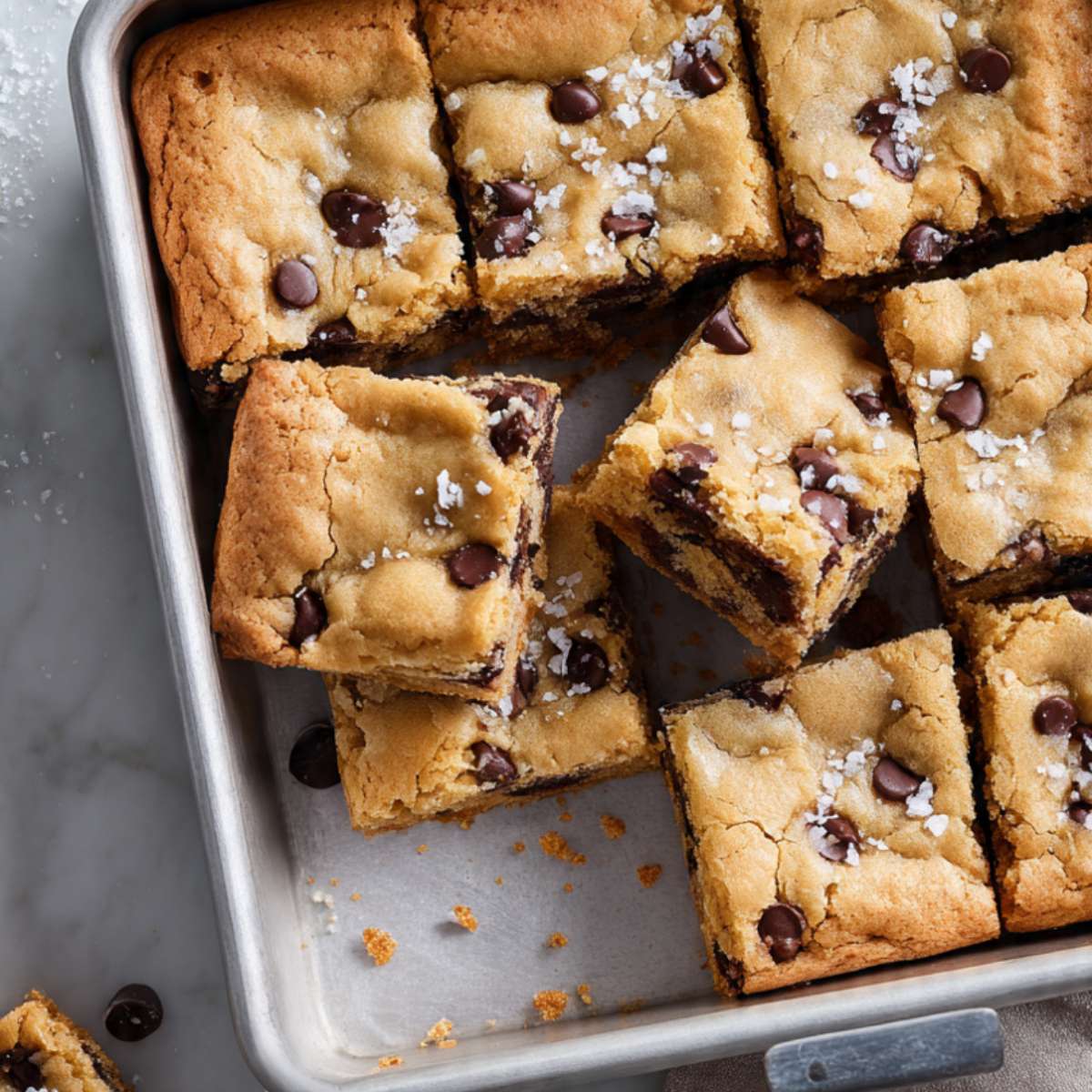
- Transfer the dough to the prepared pan and use an offset spatula or lightly dampened fingertips to press it into a completely even layer working from the center outward toward the edges and corners, then press the reserved chocolate chips onto the surface and scatter flaked sea salt such as Maldon evenly across the entire top from approximately 12 inches (30cm) above the pan.
- Bake on the middle rack at 350°F (175°C) for 22 to 26 minutes without opening the oven before 22 minutes, pulling the pan when the edges look deep golden brown and just beginning to pull from the pan walls and the center looks set but retains a faint visual softness — do not wait for the center to look fully dry or the bars will be overbaked.
- Place the pan immediately on a wire cooling rack and leave the bars completely undisturbed for a minimum of 2 hours at room temperature, then grip the parchment overhang on both long sides, lift the entire slab onto a cutting board, and cut into 16 bars using a sharp chef's knife pressed straight down in one clean motion — 3 cuts across the 9-inch width and 3 cuts down the 13-inch length.
Notes
- Butter temperature: must be below 90°F (32°C)
before adding eggs — warm butter above 95°F
partially cooks the egg proteins on contact and
produces a greasy, cakey bar instead of a
chewy one. - Vanilla extract: use pure vanilla extract only —
not imitation. Imitation vanilla has a sharp,
chemical aftertaste that is especially noticeable
in a recipe where vanilla is one of only two
flavoring agents. - Flour measuring: spoon into the measuring cup
and level with a straight edge — never scoop
directly from the bag. For best results, weigh
at exactly 240g on a kitchen scale. - Eggs: must be room temperature — pull from the
fridge 30 minutes before starting or place in
warm water for 10 minutes. Cold eggs cause the
butter to seize and the batter to look broken. - Baking soda: test for freshness before every
batch — drop ½ tsp (3g) into hot water with a
splash of white vinegar; aggressive bubbling
within 2 seconds means it is active. Replace
if it fizzes weakly. - Chocolate chips: use semi-sweet 45–55% cacao
only — such as Nestlé Toll House or Ghirardelli.
Milk chocolate chips produce a sweeter, softer
bar that does not set or cut correctly. - Pan: light-colored aluminum 9x13 inch (23x33cm)
only — dark pans overbrown the base before the
center sets. If using glass or ceramic, reduce
oven temperature by 25°F (15°C). - Parchment overhang: mandatory — leave at least
2 inches (5cm) on both long sides. Without it
the bars cannot be lifted cleanly and the edges
will crumble when cut. - Cooling: minimum 2 hours before cutting — the
center continues setting from carryover heat
during this time. Cutting early produces
crumbling edges and an underbaked-looking center. - Clean cuts: chill the fully cooled slab in the
fridge for 20 minutes before cutting — cold bars
hold their shape against the knife and produce
cleaner edges. - Make-ahead: bars are better on day 2 — bake the
day before, store uncut in a hard-sided lidded
container at room temperature overnight, cut
before serving. - Freezing baked bars: wrap each bar individually
in plastic wrap, place in a freezer-safe
container, freeze up to 2 months — thaw
unwrapped at room temperature for 45–60 minutes
or microwave at 50% power for 25–30 seconds. - Freezing unbaked dough: freeze in the pan
wrapped tightly in two layers of plastic wrap
up to 1 month — rest at room temperature
30 minutes before baking and add 5–8 minutes
to bake time. Add flaked salt after the counter
rest, not before freezing. - Scaling: do not double the baking soda if
doubling the recipe — increase by 50% only
(1½ tsp / 9g total) to avoid metallic aftertaste
and collapsed centers. Bake in two separate
9x13 inch pans. - High altitude above 3,500 feet (1,067m): reduce
baking soda to ¾ tsp (4.5g), add 2 tbsp (15g)
extra flour using the spoon-and-level method,
increase oven to 360°F (182°C), start checking
at 20 minutes. - High humidity: add 1 tbsp (8g) extra flour and
extend bake by 2–3 minutes — rely on visual
doneness cue rather than the timer. - Allergens: contains wheat, eggs, dairy, and soy
(present in most chocolate chip brands). Contains
tree nuts if optional walnuts are added.
before adding eggs — warm butter above 95°F
partially cooks the egg proteins on contact and
produces a greasy, cakey bar instead of a
chewy one. - Vanilla extract: use pure vanilla extract only —
not imitation. Imitation vanilla has a sharp,
chemical aftertaste that is especially noticeable
in a recipe where vanilla is one of only two
flavoring agents. - Flour measuring: spoon into the measuring cup
and level with a straight edge — never scoop
directly from the bag. For best results, weigh
at exactly 240g on a kitchen scale. - Eggs: must be room temperature — pull from the
fridge 30 minutes before starting or place in
warm water for 10 minutes. Cold eggs cause the
butter to seize and the batter to look broken. - Baking soda: test for freshness before every
batch — drop ½ tsp (3g) into hot water with a
splash of white vinegar; aggressive bubbling
within 2 seconds means it is active. Replace
if it fizzes weakly. - Chocolate chips: use semi-sweet 45–55% cacao
only — such as Nestlé Toll House or Ghirardelli.
Milk chocolate chips produce a sweeter, softer
bar that does not set or cut correctly. - Pan: light-colored aluminum 9x13 inch (23x33cm)
only — dark pans overbrown the base before the
center sets. If using glass or ceramic, reduce
oven temperature by 25°F (15°C). - Parchment overhang: mandatory — leave at least
2 inches (5cm) on both long sides. Without it
the bars cannot be lifted cleanly and the edges
will crumble when cut. - Cooling: minimum 2 hours before cutting — the
center continues setting from carryover heat
during this time. Cutting early produces
crumbling edges and an underbaked-looking center. - Clean cuts: chill the fully cooled slab in the
fridge for 20 minutes before cutting — cold bars
hold their shape against the knife and produce
cleaner edges. - Make-ahead: bars are better on day 2 — bake the
day before, store uncut in a hard-sided lidded
container at room temperature overnight, cut
before serving. - Freezing baked bars: wrap each bar individually
in plastic wrap, place in a freezer-safe
container, freeze up to 2 months — thaw
unwrapped at room temperature for 45–60 minutes
or microwave at 50% power for 25–30 seconds. - Freezing unbaked dough: freeze in the pan
wrapped tightly in two layers of plastic wrap
up to 1 month — rest at room temperature
30 minutes before baking and add 5–8 minutes
to bake time. Add flaked salt after the counter
rest, not before freezing. - Scaling: do not double the baking soda if
doubling the recipe — increase by 50% only
(1½ tsp / 9g total) to avoid metallic aftertaste
and collapsed centers. Bake in two separate
9x13 inch pans. - High altitude above 3,500 feet (1,067m): reduce
baking soda to ¾ tsp (4.5g), add 2 tbsp (15g)
extra flour using the spoon-and-level method,
increase oven to 360°F (182°C), start checking
at 20 minutes. - High humidity: add 1 tbsp (8g) extra flour and
extend bake by 2–3 minutes — rely on visual
doneness cue rather than the timer. - Allergens: contains wheat, eggs, dairy, and soy
(present in most chocolate chip brands). Contains
tree nuts if optional walnuts are added.